
Olive trees, silvery drought-tolerant foliage and clean architectural lines. Two recent PJR projects show why contemporary Mediterranean planting suits Melbourne's bayside suburbs so well.
Two recent projects from PJR Landscaping & Design show just how well a contemporary Mediterranean garden suits Melbourne's inner west and bayside suburbs. One sits in a heritage streetscape in Williamstown, the other in a newer courtyard build in Altona, and both lean on the same core idea: soft silvery foliage, olive trees and layered, drought-tolerant planting, dressed up with clean modern lines instead of the fussier, more ornamental Mediterranean look of decades past.
If you're weighing up a garden style for a bayside home, here's what these two gardens can tell you about how this look comes together, what it takes to grow well in our conditions, and why it's become such a natural fit for Williamstown and Altona in particular.
Why Mediterranean gardens suit Williamstown and Altona
Williamstown and Altona both sit right on Port Phillip Bay, which means salty air, sandy or clay-heavy soils, and hot, drying north winds through summer. Those are tough conditions for a lot of traditional garden plants, but they're exactly what Mediterranean and Australian coastal species are built for. Olive trees, coastal rosemary, saltbush and correa all evolved to handle poor soil, low water and wind exposure, so instead of fighting the local climate, this style works with it.
There's also a design fit. Williamstown's character homes, many with heritage weatherboard or bluestone fronts, sit comfortably alongside olive trees and silvery, textured planting that feels established rather than showy. In Altona, where a lot of newer builds favour clean rendered facades and timber screening, the same plant palette reads as more architectural, pairing naturally with concrete pavers, black cladding and minimal outdoor living spaces. Same plants, two different but equally strong results depending on the home around them.
Williamstown: a courtyard garden
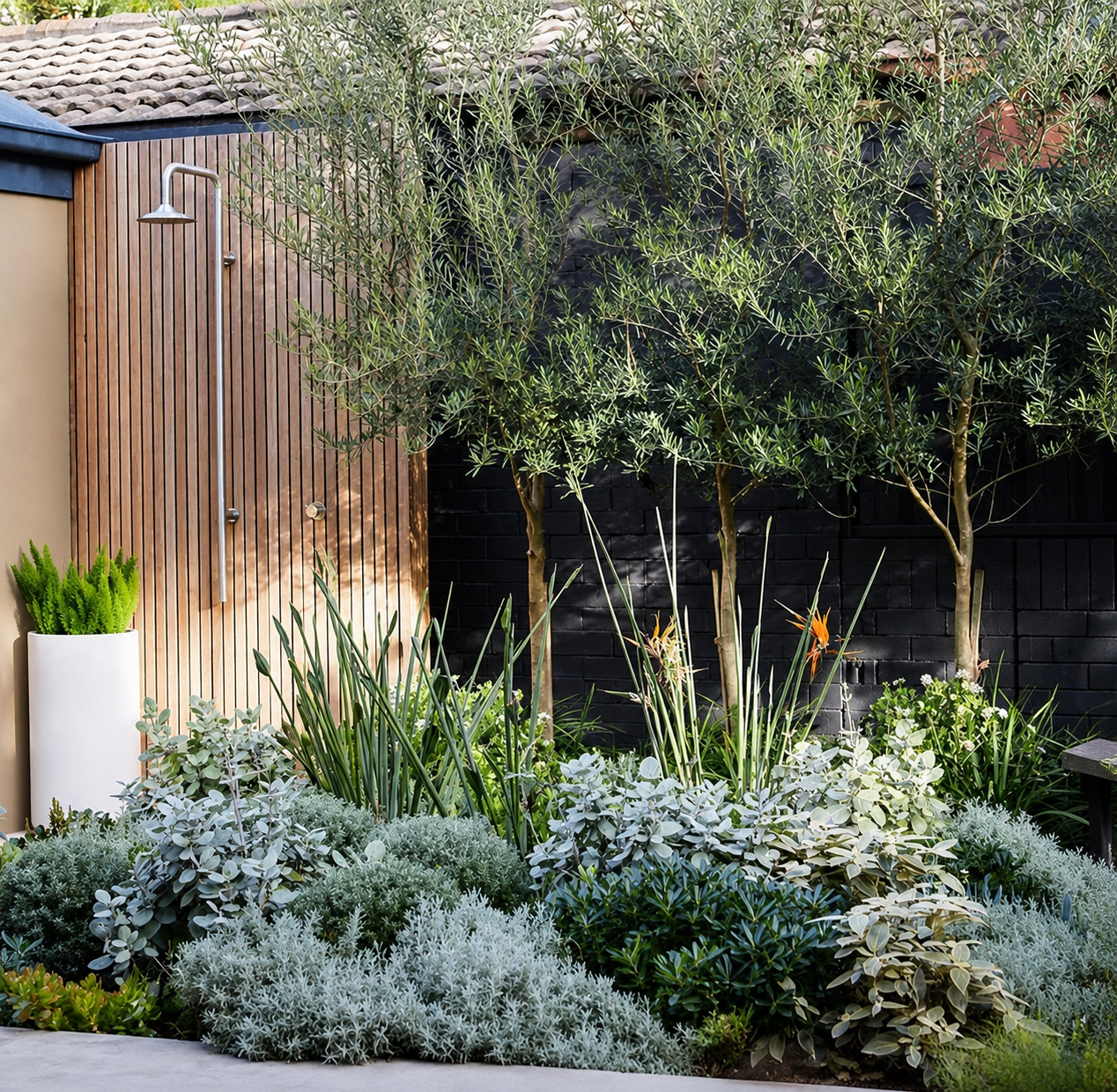
Olive trees, westringia, helichrysum and strelitzia against vertical timber screening and a charcoal block wall, Williamstown
This Williamstown project centres on a narrow side garden and outdoor shower area, framed by vertical timber screening and a charcoal-toned block wall. Multiple olive trees form the canopy layer, their silvery, wind-tolerant foliage softening the hard lines of the timber and rendered walls around them. Underneath, the planting is layered in height and texture rather than colour, which is the real hallmark of this style done well.
The plant list for this garden includes:
Olea europaea (Olive Trees)
The anchor of any Mediterranean garden, providing a light, dappled canopy and a gnarled, sculptural trunk as they mature.
Strelitzia reginae (Bird of Paradise)
Added for a burst of tropical structure and its distinctive orange and blue flower spikes, which contrast beautifully against the silver foliage around it.
Dianella (Flax Lily)
A hardy strappy-leafed native that adds vertical movement low to the ground and copes well in both sun and part shade.
Westringia fruticosa (Coastal Rosemary)
One of the most reliable performers in a bayside garden, tolerant of salt spray, wind and neglect, with fine grey-green foliage.
Helichrysum (Silver Foliage Shrub)
Prized for its almost white, felted leaves that catch the light and tie the whole silver palette together.
Atriplex cinerea (Coastal Saltbush)
A true local survivor, naturally found on Victorian coastlines and virtually indestructible once established.
Olearia axillaris (Coastal Daisy Bush)
Adding fine, feathery grey foliage and a soft, rounded shape that works well as informal low hedging.
Correa alba (Native Coastal Shrub)
A Victorian coastal native with small white flowers through the cooler months and excellent salt tolerance.
Myoporum parvifolium (Groundcover)
A fast, low, spreading native groundcover that fills gaps between larger plants and suppresses weeds.
Dichondra 'Silver Falls' (Trailing Groundcover)
Used to soften pot edges and garden bed borders with its cascading silver foliage.
Together, this palette gives the Williamstown garden real depth. There's a tree layer, a mid-height shrub layer, and a groundcover layer, all working in shades of silver, grey-green and soft white, so the garden reads as calm and cohesive rather than busy.
Altona: a corner courtyard garden
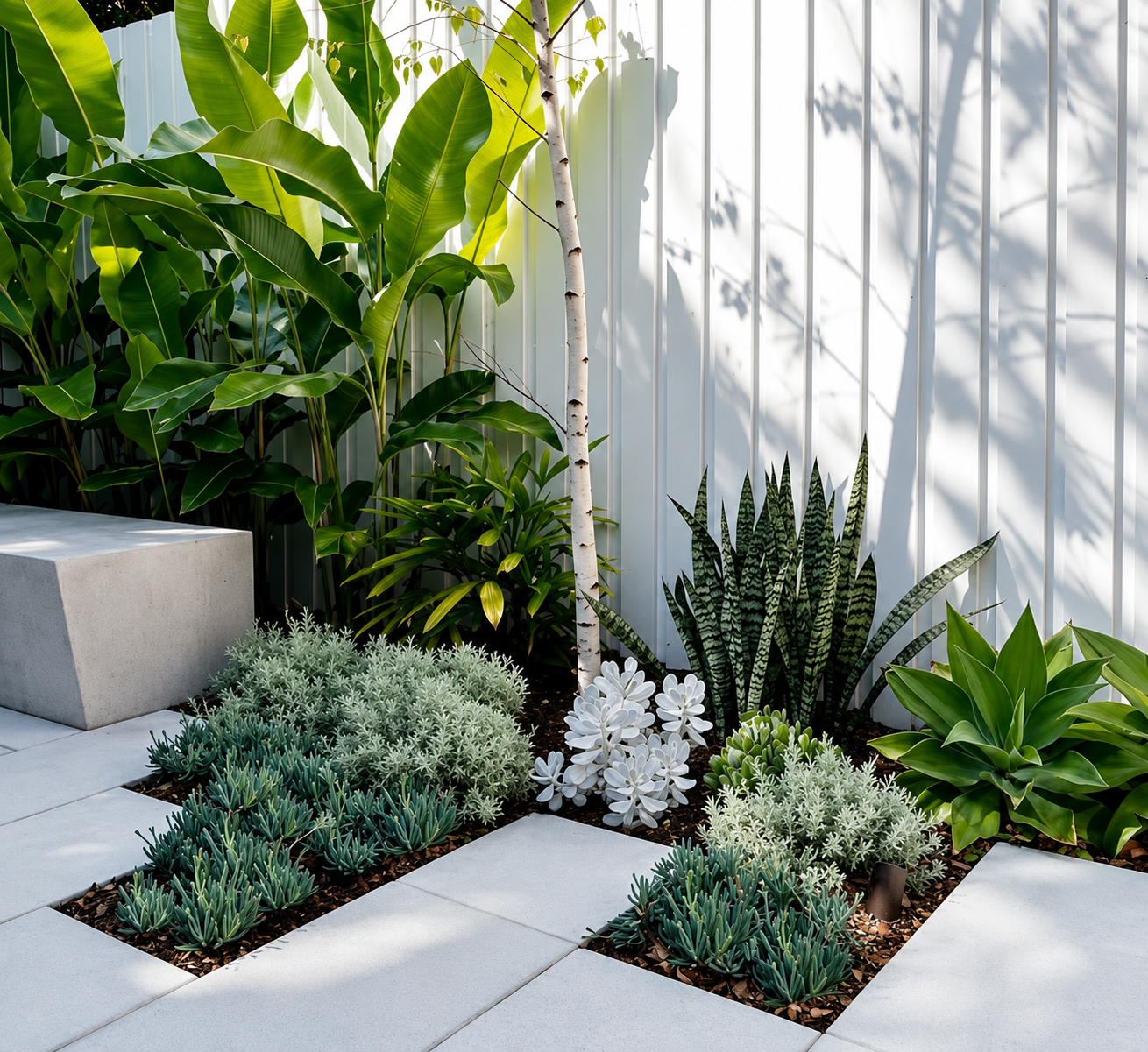
Paper bark birch, agave, snake plants and helichrysum groundcover between large format concrete pavers, Altona
The Altona project takes a similar plant palette and applies it to a different kind of space: a corner courtyard framed by white cladding, pale concrete pavers and a paper bark birch as a feature tree. Here the mood leans slightly more tropical, with tall bird of paradise and banana-leafed foliage adding height and drama against the crisp white fencing, while snake plants and agave bring architectural, sculptural shapes into the mix.
Underneath, the same drought-tolerant Mediterranean planting does the heavy lifting:
Olive Trees
Planted here as an accompanying tree layer alongside the paper bark birch, reinforcing the Mediterranean theme.
Dianella
Again bringing strappy native texture and easy-care resilience to the lower layers.
Westringia
Planted in dense clusters between the pavers, softening the geometric hardscaping with rounded, silvery mounds.
Helichrysum
Echoing the silver tones seen in the Williamstown garden and helping tie the whole scheme together.
Atriplex / Saltbush
Doing the same reliable, low-water work it does throughout bayside Melbourne.
Olearia
Adding soft, feathery texture between the harder-edged succulents and agave nearby.
Correa
Contributing small native flowers and year-round structure.
Myoporum
Spreading between pavers to give the space a slightly more relaxed, established feel.
Dichondra
Trailing along garden edges and softening the transition between paving and planting.
What stands out in the Altona garden is how the same core plant list can shift in mood depending on what it's paired with. Add a paper bark birch, snake plants and agave, and the Mediterranean base planting suddenly reads as fresh and slightly tropical, well suited to a newer home with a more contemporary architectural style.
Williamstown and Altona: two very different bayside settings
Williamstown is one of Melbourne's oldest suburbs, known for its maritime history, tree-lined streets and a strong mix of heritage cottages, Victorian terraces and bluestone buildings around the foreshore and Nelson Place. Gardens here often need to respect a streetscape with real character, which is part of why olive trees and softer, more established-looking planting tend to suit the area so well. There's also a strict heritage overlay in parts of the suburb, so any structural landscaping work, including retaining walls, fencing or significant tree removal, which usually needs to be planned with Hobsons Bay City Council requirements in mind.
Altona, just a little further along the bay, has a more relaxed, family-friendly feel, with a long stretch of beach, the Altona Pier and a growing number of newer builds alongside its established homes. Gardens here tend to have more flexibility in terms of design, which is why the Altona project could lean into a slightly bolder, more tropical-Mediterranean mix without clashing with the surrounding architecture. Both suburbs share that same coastal exposure though: salt air, wind and sandy soil, which is exactly why the same core plant palette performs so well in both.
Low water
Established plants need minimal supplementary watering
Salt tolerant
Species chosen for Melbourne's coastal conditions
Bayside
Williamstown, Altona and surrounding suburbs
Why choose PJR for a Mediterranean garden
PJR Landscaping & Design works across Melbourne's inner west and bayside suburbs, including Williamstown, Altona, Newport and the surrounding areas, designing and installing gardens that are built to handle the local climate, not just look good on install day. A Mediterranean-style garden only stays low-maintenance if the right plants go in the right positions from the start, with soil preparation, drainage and irrigation planned around how those species actually grow once established.
If you're planning a garden refresh or a full landscape design in Williamstown, Altona or nearby, PJR can help you put together a plant palette and layout suited to your home, your soil and your outlook, drawing on projects like these two as a starting point.
Areas We Service
Newport · Williamstown · Yarraville · Footscray · Kingsville · Altona · Spotswood · Seddon
Frequently Asked Questions
What makes a garden 'contemporary Mediterranean' rather than traditional Mediterranean?
A contemporary Mediterranean garden keeps the classic ingredients : olive trees, silvery foliage and drought-tolerant planting, but pairs them with clean architectural lines, minimal hardscaping and a restrained colour palette of greys, whites and soft greens. Traditional Mediterranean gardens tend to be more ornamental and symmetrical, with terracotta pots, gravel paths and clipped hedging. The contemporary version strips that back to fewer plant varieties, bolder foliage textures and a more relaxed, structural layout that suits Australian coastal homes.
Are Mediterranean gardens suitable for Melbourne's climate?
Yes. Melbourne's dry summers, cool winters and salty coastal winds in suburbs like Williamstown and Altona closely mirror the growing conditions Mediterranean and Australian coastal plants are naturally suited to. Olive trees, westringia, correa and saltbush all cope well with poor, sandy soil and long dry spells, which makes this style genuinely low-maintenance rather than just fashionable.
How much water do these gardens need once established?
Very little. Once root systems are established (usually within the first 12 to 18 months), most of the plants in a Mediterranean palette, including olive trees, westringia, atriplex and dianella, only need supplementary watering during extended dry spells. This is one of the main reasons the style has become so popular across bayside Melbourne, where water-wise gardens are both practical and increasingly expected by local councils.
How long does a garden like this take to install?
It can be as little as a few days or a few weeks, depending on the scope and size. If the project is paired with more outdoor construction work like paving, decking and other structural elements, it will take longer.
Related Services
Get in touch
Planning a Garden in Williamstown or Altona?
If you're planning a Mediterranean-style garden or a full backyard redesign in the bayside suburbs, get in touch. We'll help you put together a plant palette and layout that works with your home, your soil and Melbourne's coastal conditions.
Get in touchFurther reading
By Zahn ·