
Lawn has been the default choice in Australian gardens for decades. It's familiar, it's expected, and for many homeowners it's the first thing they specify. But in Melbourne's inner west, where blocks are compact, shade is significant, and water costs are real, lawn is often the wrong answer. Groundcovers do the same job better.
We're not anti-lawn. We install a lot of turf and it's the right call in plenty of situations: open, sunny backyards where kids need a surface to play on, or where the homeowner genuinely wants that clean open green. But we see a lot of gardens where lawn has been planted by default, without asking whether something else might work better.
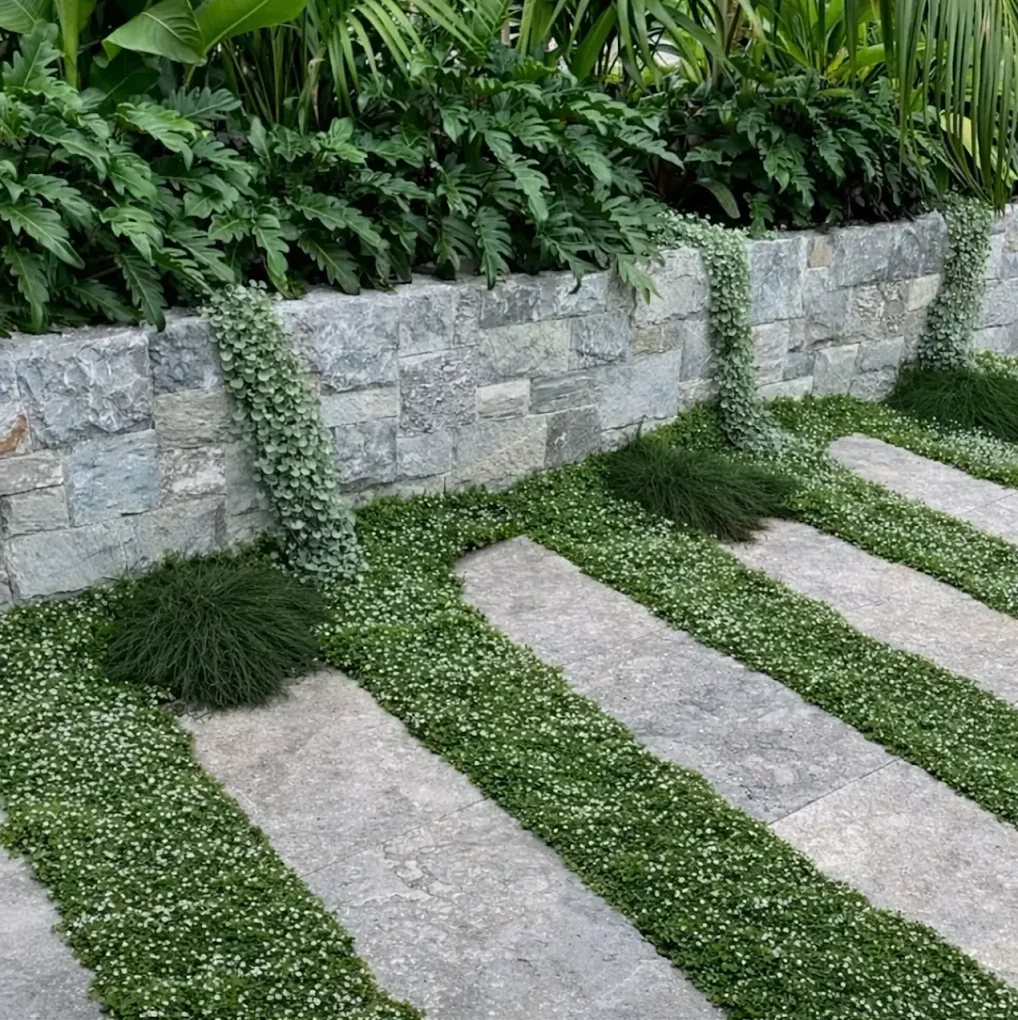
The project in the photo above is a good illustration. Large-format stone pavers with Dichondra repens filling the joints, ornamental grass clumps for punctuation, a granite-clad retaining wall with cascading groundcover softening the face, and lush tropical planting above. No lawn. Zero mowing. A garden that holds its look through every Melbourne season.
What is a groundcover and why does it matter?
Groundcovers are low-growing plants that spread horizontally to cover the soil surface. They suppress weeds, retain moisture, reduce soil erosion, and, most importantly for design purposes, create a living texture that lawn simply can't replicate.
The key difference from lawn is that groundcovers don't need mowing. Some spread by runners, some by self-seeding, and some stay in compact clumps. Once established, most require very little intervention, a trim once or twice a year at most, and almost no irrigation once the root system is established.
In Melbourne's climate, warm dry summers, cool wet winters, and clay-heavy soils, this resilience matters. Lawn demands regular water through summer and struggles in shade. Groundcovers like Dichondra and Pratia handle both conditions far better.
The best groundcovers for Melbourne gardens
The standout choice for Melbourne's inner west. Dichondra is a native groundcover with small, round, lily-pad-shaped leaves that form a dense, low carpet. It handles part shade well, looks exceptional spilling over retaining walls and between pavers, and requires almost no maintenance once established. It's particularly effective as a lawn alternative in compact gardens where a mower can't easily access corners and edges.
Similar growth habit to Dichondra with the addition of small white or pale blue star-shaped flowers through spring and summer. Pratia handles shade better than most groundcovers and works well under established trees where lawn consistently fails. It's slightly more delicate underfoot than Dichondra, so it's best suited to gardens where foot traffic is light.
A reliable choice for shaded and semi-shaded gardens. Native violet spreads by runners and forms a dense mat of heart-shaped leaves with purple and white flowers in spring. It tolerates dry shade, one of the more difficult conditions in inner Melbourne backyards, and self-manages well once established. The flowers are a genuine bonus.
A prostrate native shrub that works as a groundcover at slightly larger scale. It's faster-spreading than Dichondra, more drought tolerant, and suits sunny positions where other groundcovers struggle. The small white flowers in spring attract native bees. Good choice for front gardens with full sun and low water.
A mounding, moss-like groundcover that creates a soft, undulating texture. It's slow to establish but once in, it's virtually maintenance-free. Scleranthus works particularly well between pavers and steppers as a filler; the mounding habit creates subtle height variation that looks intentional and interesting.
Groundcovers between pavers: the detail that defines a garden
One of the most effective uses of groundcover in a Melbourne garden is as a joint filler between large-format pavers. Instead of sand or concrete grout, you plant directly into the gaps, and what grows there becomes one of the most characterful details in the entire space.
Dichondra is the most popular choice for this. Planted into prepared soil between pavers, it spreads laterally to fill each joint, creating a green grid that contrasts beautifully with the hard surface of the stone. The contrast between stone and plant (cold and warm, hard and soft, permanent and growing) is what makes it work visually.
Scleranthus works well for a slightly more sculptural look. Its mounding habit means it rises slightly above the paver surface, creating a softer, more organic edge to each stone. In a garden with a contemporary or minimalist brief, this can be exactly the right kind of imperfection.
Installation note
For groundcover between pavers to establish well, the joint needs a minimum of 50mm of quality growing medium, not sand. We use a mix of compost, fine soil, and slow-release fertiliser packed into the joint before planting. Shallow joints with compacted base material are the most common reason groundcover between pavers fails.
Groundcover on retaining walls: the cascading face
One of the most overlooked opportunities in retaining wall design is the face of the wall itself. Most walls are built, rendered or clad, and left bare, which means years of looking at an unbroken vertical surface.
Planting Dichondra, Pratia, or climbing fig (Ficus pumila) at the top of the wall and allowing it to cascade down the face transforms the look entirely. What was a hard edge becomes a soft, living surface. The wall reads as part of the garden rather than a structural necessity.
This works particularly well with natural stone and brick, where the texture of the wall face gives the trailing plant something interesting to cascade against. It's one of those details that makes a garden feel established and designed, even if the wall is only a few years old.
When lawn is still the right answer
We want to be clear: we're not suggesting groundcover for every garden. There are situations where lawn remains the better choice.
| Situation | Better choice | Why |
|---|---|---|
| Kids' play area (full sun) | Lawn (buffalo or kikuyu) | Groundcover can't handle heavy foot traffic from play |
| Open sunny backyard, 60sqm+ | Lawn | Lawn creates breathing room and works well in full sun with space to maintain |
| Compact shaded courtyard | Groundcover | Lawn thins and yellows; groundcovers handle shade far better |
| Between pavers or steppers | Groundcover | Lawn can't establish in narrow joints; Dichondra thrives |
| Slopes and banks | Groundcover | Lawn is dangerous to mow on slopes; groundcover stabilises soil without maintenance |
| Under established trees | Groundcover | Tree canopy shade and root competition make lawn almost impossible |
| Front garden / low traffic | Groundcover | Groundcover removes the need for a lawnmower in the front entirely |
How to establish groundcover successfully
Groundcovers establish faster and spread more evenly when the soil has been prepared, not just dug over. We add compost and slow-release fertiliser before planting. In Melbourne's clay soils, some gypite to break up the clay profile also helps significantly with drainage.
Plant at 200–250mm spacings for faster coverage. Going sparse to save money on plants is a false economy; it takes significantly longer to fill in, and weeds will exploit the gaps in the meantime.
Water thoroughly at planting and maintain consistent moisture for the first 6–8 weeks. Once runners or roots have established into surrounding soil, most Melbourne groundcovers become largely self-sufficient, particularly Dichondra and native violet.
The main vulnerability of a new groundcover planting is weed pressure before the canopy closes. Hand weeding in the first season is often necessary. Once the groundcover has closed over, weed pressure drops dramatically.
Groundcovers benefit from a clean edge, either a steel garden edge, a paver border, or a defined garden bed line. Without it, they tend to spread into adjacent surfaces. This is a feature in some situations and a nuisance in others, so plan for it.
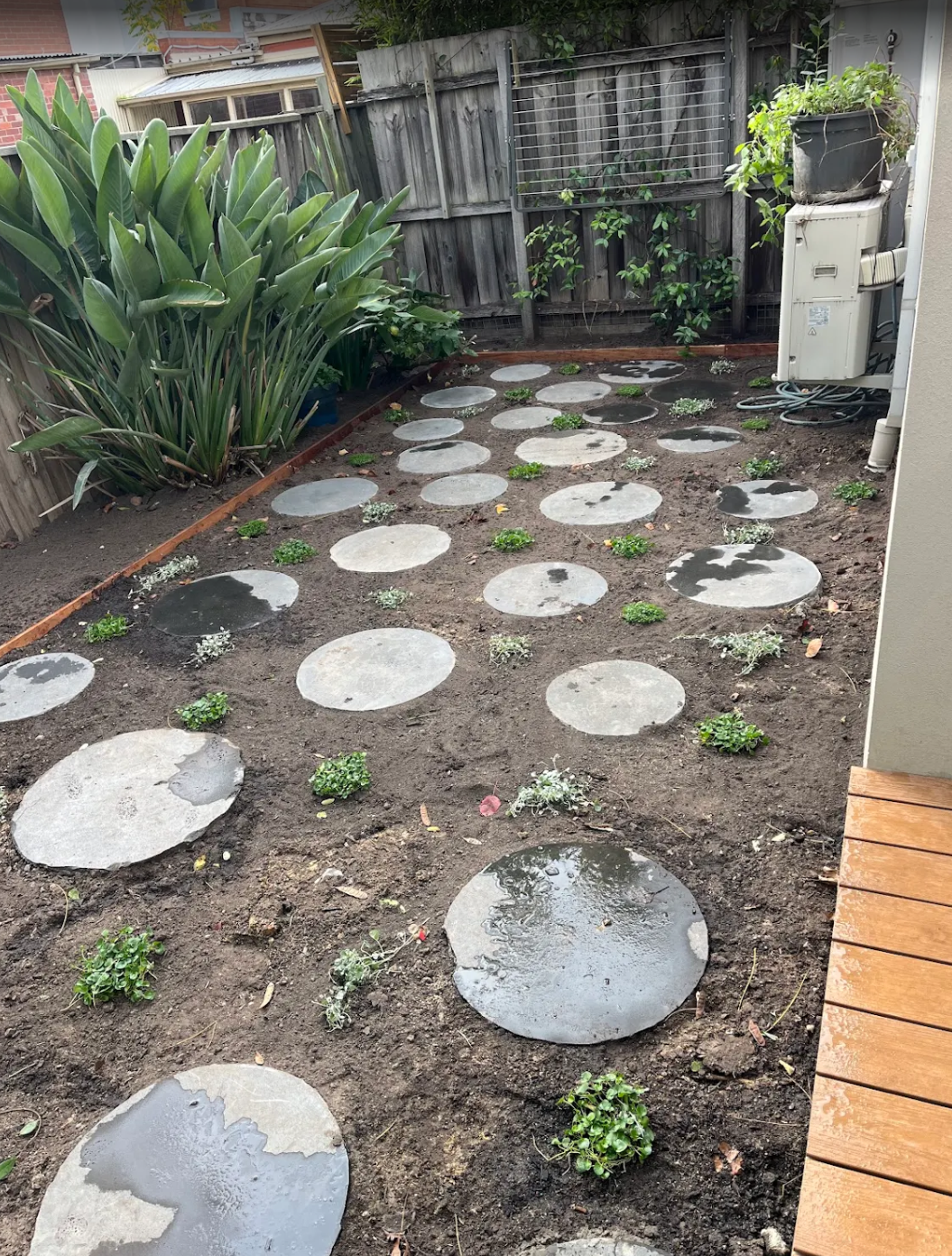
Freshly planted Dichondra between circular bluestone steppers with timber deck — Williamstown. The groundcover fills in completely within one to two growing seasons.
Frequently asked questions
Can groundcover handle foot traffic?
Most groundcovers handle light to moderate foot traffic; Dichondra and Pratia bounce back well from occasional use. For high-traffic areas or kids' play zones, lawn or a paved surface remains the better choice. The key is matching the groundcover to how the space will actually be used.
How long does it take for groundcover to fill in?
With good soil preparation and 200mm spacings, most groundcovers will fill in within one to two growing seasons. Dichondra typically covers quickly in spring and summer. Native violet spreads steadily year-round. Scleranthus is slower; allow two to three seasons for full coverage.
Is Dichondra repens native to Australia?
Yes. Dichondra repens is a native Australian groundcover species, widely distributed across eastern Australia. It's been used in Melbourne gardens for decades and is well adapted to the climate and conditions.
Can I replace my existing lawn with groundcover?
Yes, and it's one of the most common requests we get. The existing lawn needs to be removed and the soil prepared before planting. In most cases this involves scalping the lawn, spraying out remaining roots, tilling the soil, adding organic matter, and then planting into prepared ground. Allow 6–8 months before the new groundcover fully closes over.
Do you install groundcover planting in Melbourne's inner west?
Yes. Planting design and installation is part of our full landscaping service. We work across Newport, Williamstown, Altona, Yarraville, Footscray, and surrounding suburbs. We can advise on the right groundcover for your specific conditions as part of a site visit.
Related Services
Based in Newport. Working across the inner west.
Thinking about replacing your lawn?
We can advise on the right planting approach for your garden as part of a site visit. No charge for the initial consultation.
Start Your ProjectFurther reading
By Zahn ·