
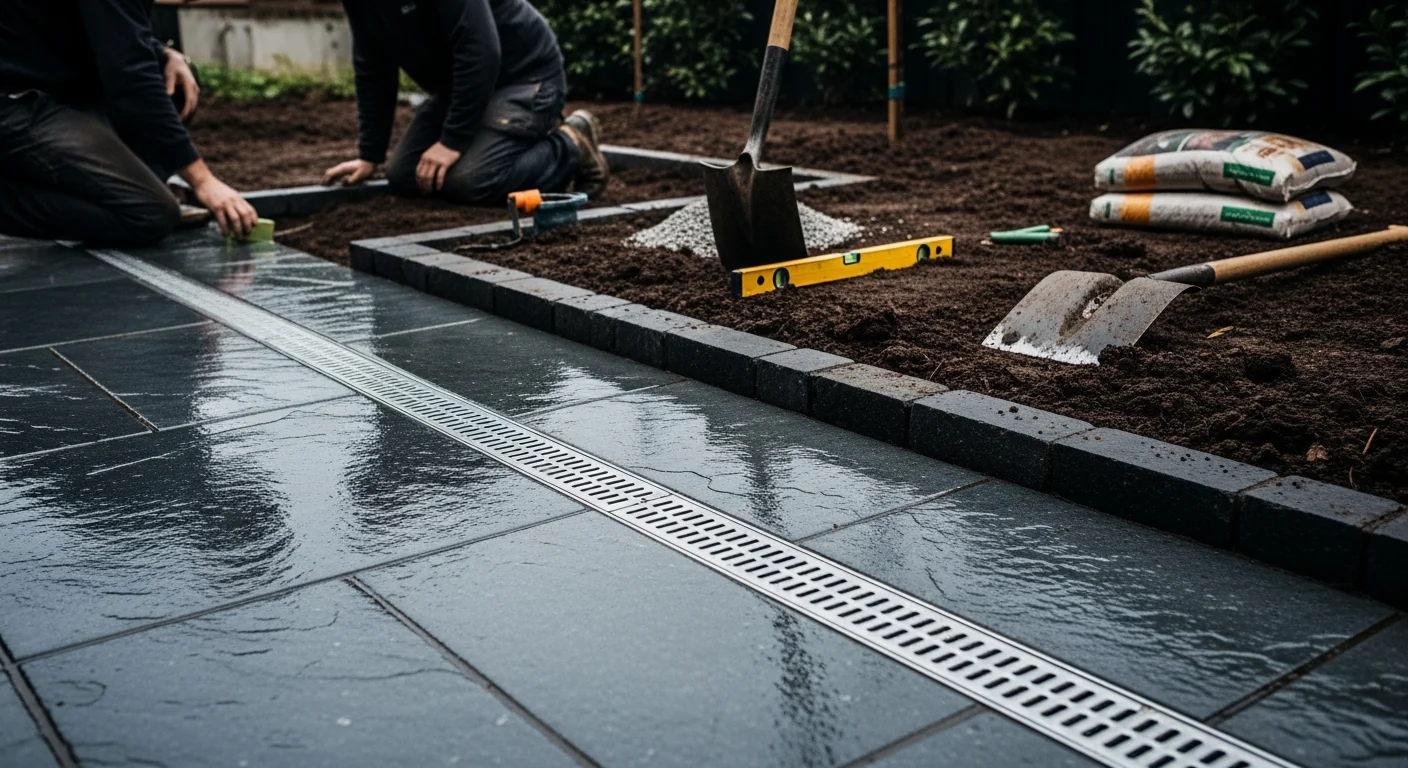
Poor drainage is the single most common cause of landscaping failure we see in Melbourne. Retaining walls that crack, lawns that rot in winter, pavers that sink and shift; nearly all of it traces back to water not going where it's supposed to. Understanding how drainage works is the foundation of any landscape that lasts.
Most homeowners don't think about drainage until something goes wrong. By then, the problem has often been developing for years, quietly saturating the subsoil, undermining structures, and creating conditions that no amount of replanting or resurfacing will fix without addressing the root cause.
Melbourne's soil makes this even more relevant. The city sits predominantly on heavy clay, which drains slowly, swells when wet, and contracts when dry. It's a difficult starting point for landscaping and one of the main reasons drainage design needs to be deliberate rather than assumed.
The signs your garden has a drainage problem
Some drainage problems are obvious. Others develop slowly and only become visible after they've caused secondary damage. Here's what to look for:
Standing water after rain
Water that pools on the lawn or paving and takes more than a couple of hours to drain is a surface drainage failure. In clay soils, some pooling is normal, but persistent pooling indicates a grading or outlet problem.
Permanently soggy lawn patches
If parts of your lawn stay wet for days after rain or feel spongy underfoot year-round, you likely have a subsurface drainage problem. Water is saturating the root zone and has nowhere to go.
Cracking or leaning retaining walls
Hydrostatic pressure, the weight of water-saturated soil pressing against a structure, is the most common cause of retaining wall failure. If your wall is cracking or leaning, drainage behind it has almost certainly failed.
Sunken or shifting paving
Pavers that have settled unevenly or shifted out of alignment are often sitting on subsoil that has been repeatedly wetted and dried. Clay soil expansion and contraction cycles undermine the base over time.
Damp along fence or building bases
Water staining, mould, or persistent damp at the base of fences, garden walls, or the house itself indicates that water is being directed toward these structures rather than away from them.
Dead lawn in winter
A lawn that dies during winter despite not being dry is usually drowning, not freezing. Waterlogged root zones prevent oxygen exchange and roots die, commonly misdiagnosed as disease or pest damage.
Important
If you have any of these symptoms adjacent to your home's foundation, address it promptly. Water ingress and soil movement near foundations can cause structural damage that is significantly more expensive to rectify than a landscaping drainage system.
The two types of residential drainage
Residential drainage breaks into two distinct systems that solve different problems. Many Melbourne properties need both.
Surface drainage
Surface drainage manages water that sits on top of the ground: rain runoff from paving, roof runoff from downpipes, and water that sheets across the garden after heavy rain. It works through a combination of grading (slope), collection points, and outlets.
The principle is simple: every hard surface and lawn area should have a fall (a slope) that directs water toward a collection point and from there to an outlet. The standard grading minimum for hard surfaces is 1:100, one centimetre of fall for every metre of run.
When surface drainage fails, it's usually because grading is insufficient or has been disrupted, downpipes are discharging directly onto the lawn without a stormwater connection, or existing pits and channels are blocked with debris.
Subsurface drainage
Subsurface drainage manages water within the soil, the groundwater that saturates clay profiles after prolonged rain and has no natural path to escape. It uses slotted agricultural pipe (ag pipe) buried in a gravel bed to intercept water below the surface and carry it to an outlet.
How ag pipe works
Agricultural pipe (ag pipe) is a flexible, slotted pipe wrapped in geofabric and bedded in coarse gravel. Water from the surrounding saturated soil enters through the slots, flows along the pipe by gravity, and exits at a lower point, typically a stormwater pit, a catchment area, or a lower section of the garden. The geofabric prevents fine soil particles from blocking the slots over time.
How a complete drainage system is designed
A properly designed residential drainage system addresses both surface and subsurface water movement and ensures they connect to an appropriate outlet. Here's how the design process works:
Site assessment and fall mapping
The first step is understanding where water currently goes, and where it needs to go. This means identifying the natural fall of the block, locating existing pits and stormwater connections, and identifying any low points where water currently pools.
Soil testing
Understanding how the soil profile behaves is essential in Melbourne. A simple percolation test reveals how quickly water moves through the soil and where any clay layers are. This determines whether subsurface drainage is needed and how deep it needs to go.
Surface grading design
Every surface (lawn, paving, garden beds) is designed to slope away from structures at the correct gradient. Paved areas typically need 1:100 minimum fall; lawn areas can tolerate gentler grades. This is established during earthworks before any surfaces are installed.
Subsurface drainage layout
Ag pipe runs are planned to intercept the highest-risk areas, typically along fence lines, behind retaining walls, and across the upslope edge of the garden. Pipes are sloped toward a collection pit at a minimum of 1:200 fall and connected to a suitable outlet.
Outlet connection
All drainage must have somewhere to go. In Melbourne, residential drainage typically outlets to the council stormwater system via an existing connection, a charged pit that absorbs into the subsoil, or where blocks have sufficient fall and space, a drainage easement or street channel.
Drainage and retaining walls
Retaining walls deserve specific attention because drainage failure and wall failure are directly linked. Any wall that retains soil is retaining water as well, and water is heavy. A saturated soil profile behind a retaining wall generates hydrostatic pressure that the wall structure must resist in addition to the weight of the soil itself.
Every retaining wall installation should include drainage behind the wall. This typically means a coarse gravel backfill layer immediately behind the wall face, ag pipe running along the base of the wall, and weepholes through the wall at regular intervals to allow any accumulated water to escape.
In our experience, most cracked or failed retaining walls we're asked to assess in Melbourne were either built without drainage, or the drainage was installed incorrectly and has become blocked over time. Rebuilding a failed wall without addressing the drainage that caused the failure just results in the same outcome again.
What drainage work actually costs in Melbourne
| Drainage type | Typical application | Approx. cost |
|---|---|---|
| Surface regrading (lawn area) | Correcting minor pooling on flat lawn | $400 – $1,200 |
| Channel drain installation | Driveway or paved area drainage | $800 – $2,000 |
| Downpipe connection to stormwater | Redirecting roof runoff off lawn | $400 – $900 per downpipe |
| Subsurface ag pipe system | Waterlogged lawn, saturated garden beds | $2,500 – $6,000+ |
| Retaining wall drainage | New or rebuilt retaining wall | Included in wall cost |
| Full garden drainage system | Comprehensive surface + subsurface solution | $4,000 – $12,000+ |
The most important cost consideration is timing. Addressing drainage before installing new landscaping costs a fraction of what it costs to rectify drainage problems after the fact. In our experience, homeowners who defer drainage work to save money on a landscaping project almost always spend more total than if they'd addressed it upfront.
When to call a professional
Minor surface drainage improvements are within reach of a capable DIY homeowner. Cleaning out blocked pits, extending a downpipe connection, or regrading a small garden bed are straightforward tasks.
Anything that involves subsurface drainage, connection to council stormwater infrastructure, drainage behind retaining walls, or drainage adjacent to a building foundation should be handled by a professional. Incorrect subsurface drainage can redirect water toward foundations or neighbouring properties, creating problems that are significantly worse than the original issue.
Frequently asked questions
How do I know if my garden has a drainage problem?
The most obvious signs are water pooling on the surface after rain that takes more than a few hours to drain, persistently soggy lawn areas, lawn that dies in patches during winter despite not being dry, cracks in retaining walls or paving, and damp or water staining along the base of fences or buildings. In Melbourne, clay soil means drainage problems are more common than most homeowners expect.
What is the difference between surface drainage and subsurface drainage?
Surface drainage manages water that sits on top of the ground. It uses grading, channel drains, and pits to move water across the surface to an outlet. Subsurface drainage manages water that saturates the soil. It uses slotted pipes buried in gravel beds to intercept groundwater and carry it away before it becomes a surface problem. Many Melbourne properties with clay soils need both systems working together.
Can I fix garden drainage myself?
Minor surface drainage improvements like regrading a garden bed or installing a simple channel drain are achievable DIY projects. However, subsurface drainage systems, retaining wall drainage, and any work that involves connecting to council stormwater infrastructure requires professional installation. Incorrect subsurface drainage can make problems worse by directing water toward foundations or neighbouring properties.
How much does drainage installation cost in Melbourne?
A basic surface drainage system with a channel drain and connection to an existing outlet costs approximately $800 to $2,000 depending on run length and access. A full subsurface drainage solution for a waterlogged backyard typically runs $2,500 to $6,000 or more depending on the extent of the problem and whether retaining walls or paving are involved.
Why does Melbourne clay soil cause so many drainage problems?
Melbourne's predominant soil type is heavy clay, which has very low permeability; water moves through it slowly and it becomes waterlogged easily. Clay also expands when wet and contracts when dry, which causes heaving and cracking in paving and retaining walls over time. Proper drainage design in Melbourne always needs to factor in clay soil management.
Related Service
PJR Full Landscape Construction Melbourne — drainage, paving, planting & more, one team start to finish →Think you might have a drainage problem?
Book a drainage assessment
PJR offers drainage assessments and full drainage system installation across Melbourne. If your garden is pooling, your lawn is struggling through winter, or you have a retaining wall showing signs of movement. Get in touch before it becomes a bigger problem.
Get In TouchFurther reading
By Zahn ·