
Most people call us about retaining walls because they have a problem. A sloped block. Erosion. A garden bed that keeps collapsing into the path. Solving that problem is exactly what a retaining wall does, but if you go into it thinking purely about function, you'll miss the opportunity sitting right in front of you.
A retaining wall is one of the most structurally significant things you can add to a garden. It changes levels, creates definition, and becomes a hard landscape element you'll look at every day for the next 30 years. Getting the material choice, the height, and the planting around it right matters enormously.
We've built a lot of retaining walls across Melbourne's inner west, from Newport to Williamstown to Yarraville, and we've seen the difference between a wall that just does the job and one that genuinely lifts a garden. This is what we've learned.
Why retaining walls fail (and how to avoid it)
The number one cause of premature retaining wall failure in Melbourne is drainage. Our clay-heavy soils hold water, and when it builds up behind a wall with nowhere to go, the pressure eventually wins. We've seen walls push out, crack, or tip forward entirely, sometimes within five years of being built.
The second most common issue is footings. A wall that looks solid above ground can still fail if it's not properly anchored below, especially on sloped or unstable ground. Height matters here too: anything over 600mm starts to carry significant lateral load and needs to be engineered accordingly.
In Victoria, retaining walls over one metre typically require a building permit. A reputable landscaping contractor will flag this during the quoting process.
From the field
"The drainage is invisible once the job is done, but it's what the whole wall is built on. Skip it and you're counting down the years."
Proper construction means: compacted base, concrete footings, geofabric behind the wall, agricultural pipe at the base, and drainage aggregate backfilled before soil goes in. It adds to the cost, but it's what separates a wall that lasts from one that doesn't.
Choosing the right material
Material choice comes down to three things: the style of your home, the look you want in the garden, and your budget. There's no universally right answer, but there are better and worse fits.
Character Homes
Recycled Brick
Warm, tactile, and full of character. Recycled bricks carry a history that new materials can't replicate. They suit period homes and cottage gardens beautifully, and age gracefully. Higher labour cost, but the finish justifies it.
Modern / Contemporary
Concrete Block
Clean lines, consistent finish, strong. Concrete block is the workhorse of retaining wall construction and works well in contemporary gardens where you want the planting to do the talking.
Informal / Relaxed
Timber Sleepers
Approachable and warm, sleepers suit informal garden layouts and work well in tiered veggie gardens or cottage-style spaces. Shorter lifespan than masonry, but often the best fit for lower walls.
Premium
Natural Stone
The premium option. Natural stone walls have an organic quality that's hard to manufacture, and hold their value well. Suited to high-end landscaping projects where the wall is a feature in its own right.
A recent project: Newport entry garden
One of the jobs we're most proud of recently was a front entry garden in Newport. The brief was simple: the existing garden felt flat and unloved, and the homeowner wanted something with a bit of soul.
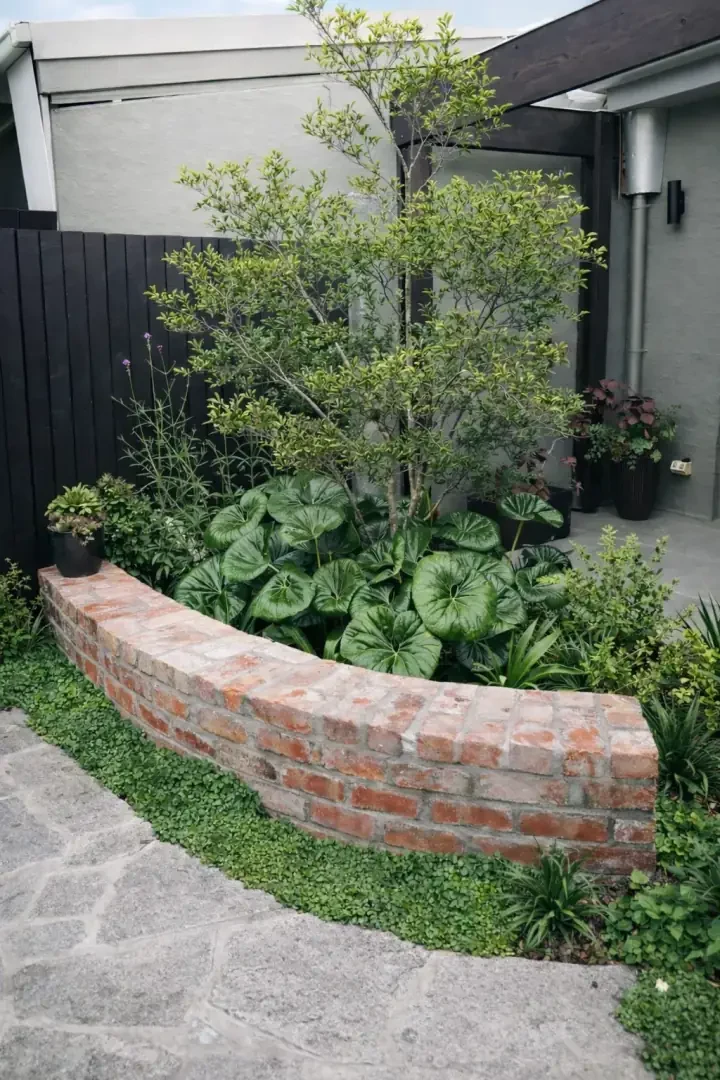
We chose recycled brick for the character it brings. The house is a period home in Newport and we wanted a material that felt like it had always been there. Rather than a straight run, we curved the wall to wrap around the established Lilly Pilly at the centre of the garden, giving the whole space a sense of intention and age.
The planting palette was deliberately lush but low maintenance: Dichondra repens as groundcover, Alocasia for bold tropical leaf contrast, and a mix of native understorey plants to soften the brick. The Dichondra spilling over the front face of the wall was the detail that tied it together. It stops the wall from looking new and gives the garden that settled, established feeling that's hard to manufacture.
The result is a front garden that stops people on the street. Not because it's showy, but because it has a quality to it. That's what a well-built retaining wall, matched to the right planting, can do.
Retaining walls and planting: getting the two to work together
The wall and the planting are two halves of the same decision. A bare brick wall looks hard and industrial. A wall with the wrong plants looks like an afterthought. The best gardens treat the two as one design.
For lower walls (under 600mm), cascading groundcovers that spill over the front face are almost always a good idea. Dichondra repens, Pratia, or even low-growing Thyme work well and soften the edge considerably. For taller walls, layered planting at the base draws the eye up and gives the wall a sense of scale.
Consider texture contrast too. Smooth concrete block reads well next to fine-leafed ornamental grasses. Recycled brick pairs naturally with broader tropical leaves or dense native shrubs. The contrast between hard and soft is what makes a garden feel designed rather than assembled.
What does a retaining wall cost in Melbourne?
It's one of the first questions we get asked, and the honest answer is: it varies significantly. Material, height, length, site access, drainage requirements, and council permits all affect the final number.
As a rough guide for Melbourne in 2025: timber sleeper walls typically start around $250–$400 per square metre installed. Concrete block sits at $300–$500. Brick and natural stone generally run from $400–$700 per square metre depending on complexity and material sourcing. Any wall over a metre that requires engineering or permits will add to that. The best approach is to get a proper quote from a licensed landscaping contractor who will inspect the site and price accordingly.
Frequently asked questions
Do I need a permit to build a retaining wall in Melbourne?
In Victoria, retaining walls over 1 metre in height generally require a building permit. If the wall is near a boundary, easement, or drainage line, additional approvals may apply. Your landscaping contractor should advise based on your site and local council requirements.
How long does a retaining wall last?
A properly built wall with good drainage should last 20 to 50 years depending on material. Timber sleepers typically last 15 to 25 years. Brick, concrete, and stone walls can last 40 to 60 years or more when built on correct footings with adequate drainage behind them.
What is the best material for a retaining wall in Melbourne?
It depends on your home's style, budget, and the look you want. Recycled brick suits period homes and character gardens. Concrete block works well in contemporary spaces. Timber sleepers suit lower, informal walls. Natural stone is the premium option for high-end landscaping.
Can a retaining wall be a feature rather than just functional?
Absolutely, and this is the approach we take at PJR. Material choice, wall shape, height variation, and the planting around and above the wall all contribute to whether a retaining wall becomes a feature or just blends into the background. A curved recycled brick wall with cascading groundcover can become the centrepiece of a front garden.
Are you building retaining walls in Newport and Melbourne's west?
Yes. PJR Landscaping & Design is based in Newport and works across Melbourne's inner west including Williamstown, Altona, Yarraville, Footscray, and surrounding suburbs. Get in touch for a site visit and quote.
Related Service
PJR Retaining Walls Melbourne — timber sleeper, concrete block & natural stone, built by our own team →Based in Newport. Working across the inner west.
Thinking about a retaining wall?
We're based in Newport and work across Melbourne's inner west. Get in touch for a site visit and quote. No charge for the consultation.
Start Your ProjectFurther reading
By Zahn ·