
Yarraville backyards are some of the most characterful and challenging spaces we work in. Narrow, shaded, hemmed in by fences and neighbouring terrace rooflines, they demand design thinking rather than just landscaping. Here's what we've learned from working in the suburb.
The character of a Yarraville backyard
Yarraville is one of Melbourne's most loved inner-west suburbs, a dense pocket of Victorian and Edwardian workers' cottages and terrace homes, most of them on blocks between 200 and 350 square metres. The suburb sits in the Maribyrnong council area, roughly five kilometres from the CBD, and has changed dramatically over the past two decades as the original working-class demographic gave way to young families, design professionals, and long-term residents who've renovated extensively.
The backyards reflect that evolution. You'll find original concrete slabs from the 1980s sitting alongside new extensions with architect-designed kitchens. Outdoor space is precious; most blocks don't allow for the sprawling lawns that outer-suburb homes take for granted, so every square metre matters. The homes that have done it well treat the backyard as an extension of the interior, not an afterthought.
The typical challenges are consistent: limited width, boundary fences that block afternoon light, clay subsoil that drains poorly, and a desire to fit living space, garden interest, and low maintenance into a compact footprint. These are problems we solve regularly in Yarraville.
What the homes are like
Most Yarraville homes sit on 200–350sqm lots. Backyards typically range from 60 to 150sqm, compact by Melbourne suburban standards, but well-suited to considered landscaping rather than open lawn.
Clay-dominant subsoil is common throughout the inner west. Without adequate drainage preparation, water sits on the surface after heavy rain and causes paving to heave and planting to struggle. Good base preparation is non-negotiable.
Boundary fences of 1.8–2m combined with neighbouring two-storey extensions means many Yarraville backyards receive direct sun for only a few hours each day. Plant selection and surface choice need to account for this.
Parts of Yarraville fall within a heritage overlay. Front gardens and facades may require council approval for changes. Rear yards are generally unconstrained, but it's worth checking with Maribyrnong Council before major works if you're unsure.
Our Yarraville work: Steel Ring Garden Beds & Gravel Pathway
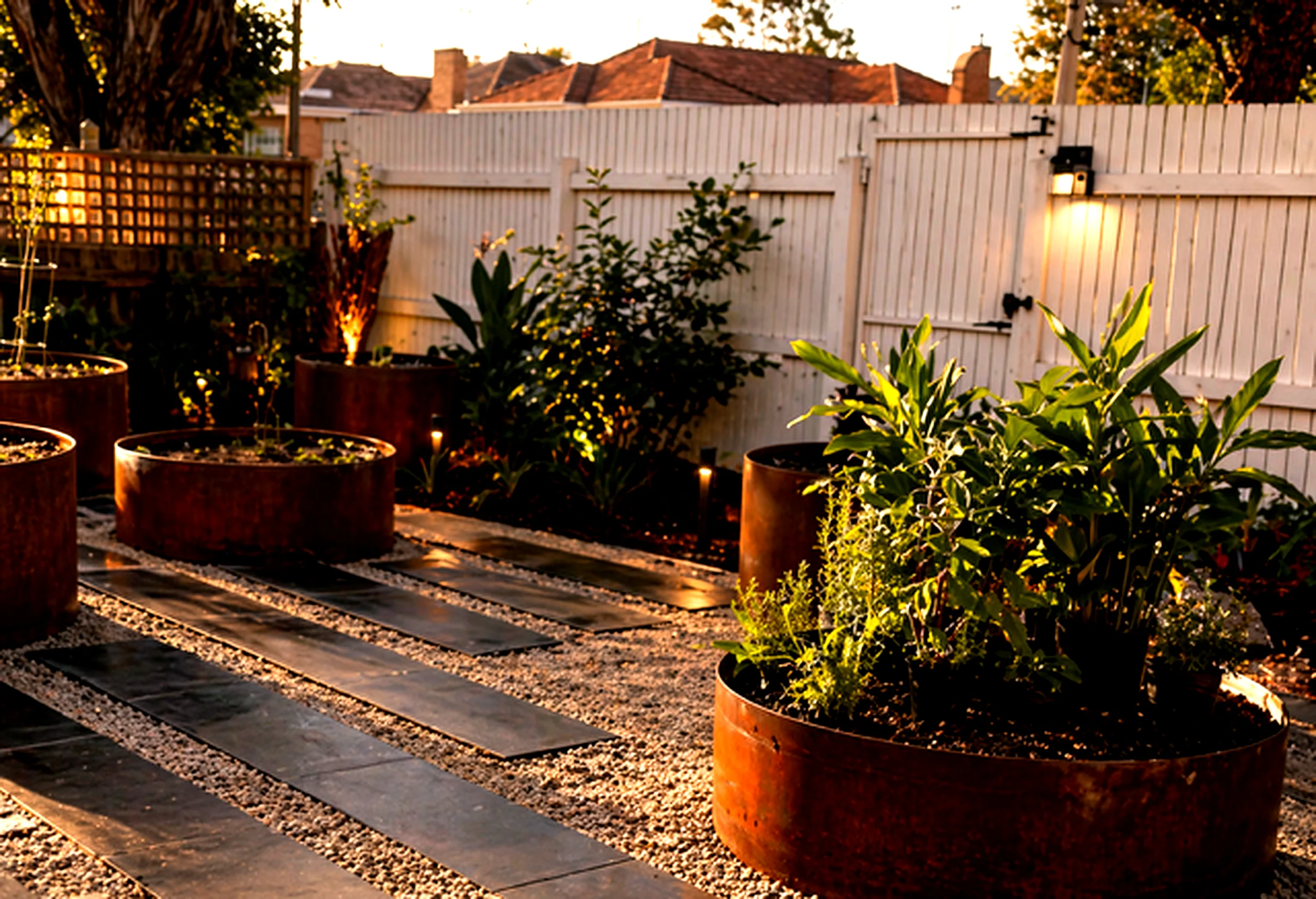
This project in Yarraville is a good example of how to bring structure and low maintenance to a compact rear yard without it feeling overdone. The clients wanted something that looked considered and architectural (not a standard paved-and-turfed backyard) but that was also practical for day-to-day life.
We used Formboss steel ring raised garden beds as the central design element. The circular forms work well in a tight backyard because they break the rigid line of boundary fences and bring organic shape into the space. Set on compacted decomposed granite with bluestone steppers threading through, the layout creates a clear pathway while leaving room for planting that will evolve over time.
Gravel as a base material was the right call here. It's significantly cheaper than paving over the full area, drains excellently (important for Yarraville's clay subsoil), and maintains a clean, contemporary look that complements the steel edging. The steppers give a defined movement path without the cost of a full bluestone pave.
Design note
Steel ring garden beds are particularly effective in inner-west Melbourne homes because they provide visual height and planting depth without requiring large excavation. They're also durable enough to withstand Melbourne's seasonal swings without cracking or shifting, a real issue with rendered garden bed walls in clay-heavy ground.
Our Yarraville work: Bluestone Pathway & Barrel Sauna
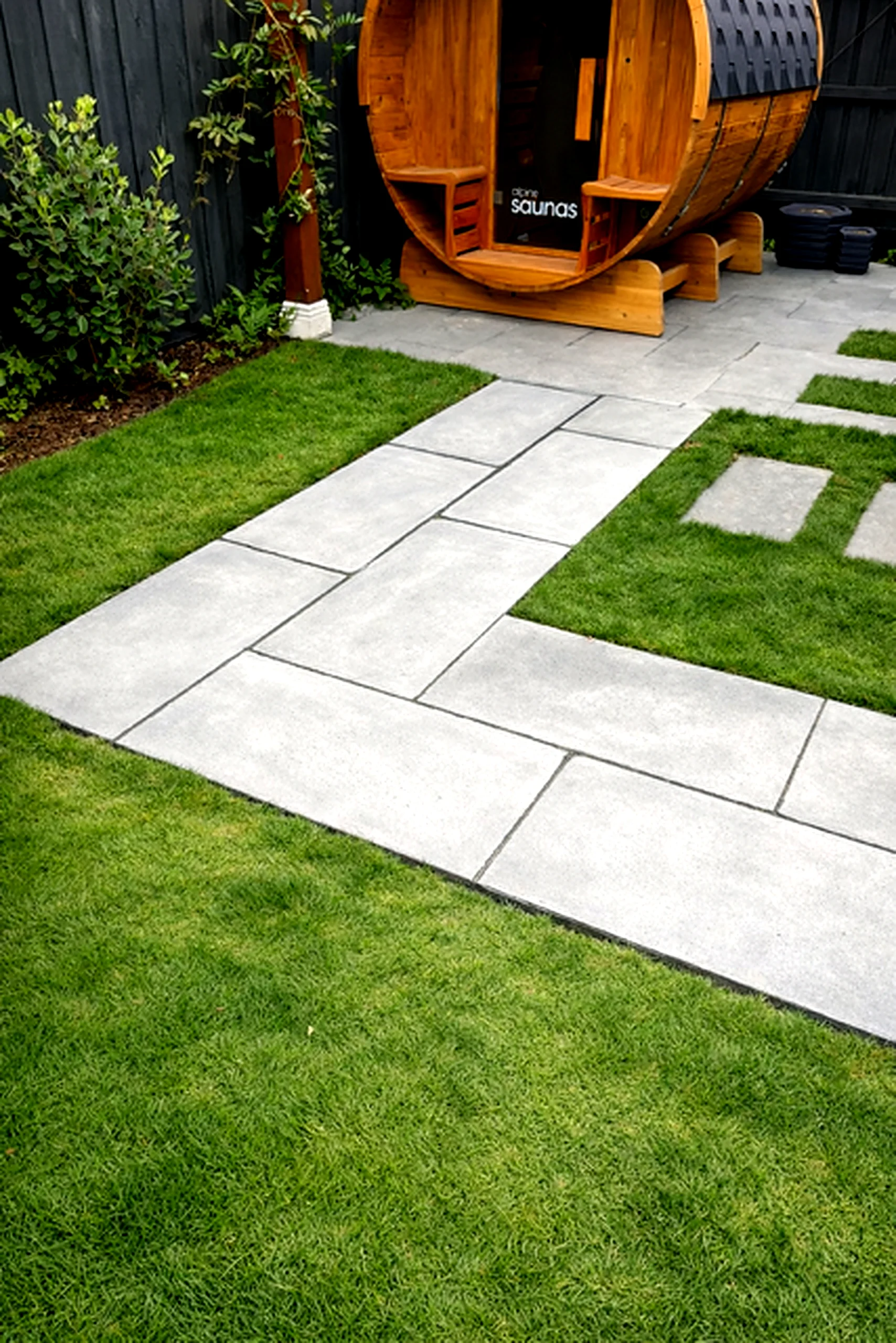
Bluestone steppers through open turf leading to a barrel sauna, Yarraville, Melbourne
This second Yarraville project took a different approach. The clients' priority was relaxation. They wanted a backyard that felt open and uncrowded, with a clear destination: a barrel sauna as the centrepiece.
Large-format bluestone steppers set directly into open turf are one of the most elegant solutions for connecting a rear entry to a garden structure. The path is generous enough to walk comfortably, the steppers complement the sauna's timber aesthetic, and open lawn surrounds the whole space, giving the yard a feeling of breathing room that smaller Yarraville blocks don't always naturally provide.
The layout is deliberately minimal. No raised beds, no feature walls, no layered planting. The barrel sauna is strong enough visually to carry the space on its own, and cluttering the surrounding area would have undercut its impact. The open turf also makes the yard feel larger than it is, a useful perceptual trick on a narrow block.
Turf note
For inner-west Melbourne blocks with limited direct sunlight, we typically recommend a buffalo variety (Sir Walter or Palmetto) for open lawn areas. These handle shade better than kikuyu or couch and stay green through Melbourne's cooler months with minimal intervention.
What works well in Yarraville gardens
| Element | Why it works | What to avoid |
|---|---|---|
| Bluestone paving | Suits Victorian heritage character, drains well, ages gracefully | Full-area concrete slab: heat retention and heritage clash |
| Steel garden edging | Architectural, durable, works with gravel and turf equally well | Treated pine edging: degrades quickly in wet clay conditions |
| Gravel + steppers | Cost-effective, excellent drainage, contemporary finish | Fine decorative gravel: tracks into the house easily |
| Raised garden beds | Overcomes clay soil, creates height and planting depth | In-ground planting without amended soil in clay-heavy blocks |
| Buffalo turf | Shade tolerant, low maintenance in cooler months | Kikuyu in predominantly shaded yards: will thin and yellow |
| Feature structures | Sauna, pergola, or deck as a destination point | Too many competing elements in a compact space |
Planting that suits Yarraville's conditions
Inner-west Melbourne gardens are often shadier and more sheltered than people expect. The right plant selection makes the difference between a garden that struggles through winter and one that holds its form year-round.
Dichondra repens, Pratia pendunculata, and Viola hederacea work well under established trees and in partially shaded areas. They spread without aggressive maintenance and stay green through Melbourne's cooler months.
Dianella, Lomandra, and Baumea species provide upright structural interest in garden beds without high water needs. They're well-suited to Yarraville's conditions and hold up in both sun and part shade.
Japanese maples, ornamental pears (Pyrus calleryana), and Magnolia 'Little Gem' all work for compact Yarraville blocks. They provide seasonal interest without the root spread of larger trees that can damage paving and fences.
Star jasmine (Trachelospermum jasminoides) is the go-to for Yarraville boundary fences; it softens the hard fence line, handles part shade, is low maintenance, and smells excellent in spring and summer.
Frequently asked questions
Do you do landscaping in Yarraville?
Yes. Yarraville is one of our regular working areas. We've completed multiple projects in the suburb ranging from full backyard transformations to pathway and garden bed construction. We're familiar with the typical block sizes, soil conditions, and drainage challenges specific to Yarraville and the surrounding inner west.
How much does landscaping cost in Yarraville?
Project cost depends heavily on scope and materials. A pathway with garden bed construction in a compact Yarraville backyard might start from $8,000 to $15,000. A full rear yard transformation including paving, structure, turf, and planting typically ranges from $25,000 to $60,000+. We provide detailed quotes after a site visit. There's no charge for that consultation.
Can you work in Yarraville's heritage overlay areas?
Front facades and front gardens in some parts of Yarraville fall within a heritage overlay and may require planning approval for changes. Most rear yard work is unaffected. We'll flag any potential heritage considerations when we visit your property.
What's the best surface for a small Yarraville backyard?
Bluestone paving is the most popular choice for inner-west Melbourne homes; it suits the heritage character of the suburb, holds up well in Melbourne's climate, and ages gracefully. For lower budgets, a gravel base with bluestone steppers achieves a similar aesthetic at lower cost. We don't recommend cheap concrete pavers in heritage areas as they clash with the surrounding streetscape.
How do you handle drainage in Yarraville?
Clay subsoil is the baseline in most of inner-west Melbourne, including Yarraville. Every paved project we do includes a properly designed drainage solution: graded falls to a drainage channel or agricultural pipe, with aggregate bedding below the base course to allow water movement through the profile. We never rely on surface fall alone in clay-dominant sites.
Related Service
PJR Full Landscape Construction Melbourne — paving, decking, planting & structures, one team start to finish →Based in Newport. Working across the inner west.
Get a quote for your Yarraville project
We visit Yarraville regularly and understand the specific constraints of inner-west Melbourne blocks. One team, start to finish.
Start Your ProjectFurther reading
By Zahn ·